|
Foot Anchors - there when you need'em TM FootAnchors.com
The New Body Position While Cornering
The
idea, the discovery, and the refinement of the proposed new body position
stems from one key aspect of riding - how rider's eyes should be looking through
a turn. The generally accepted wisdom is that rider should keep his eyes
leveled with the horizon, trying to keep the view of the world...well,
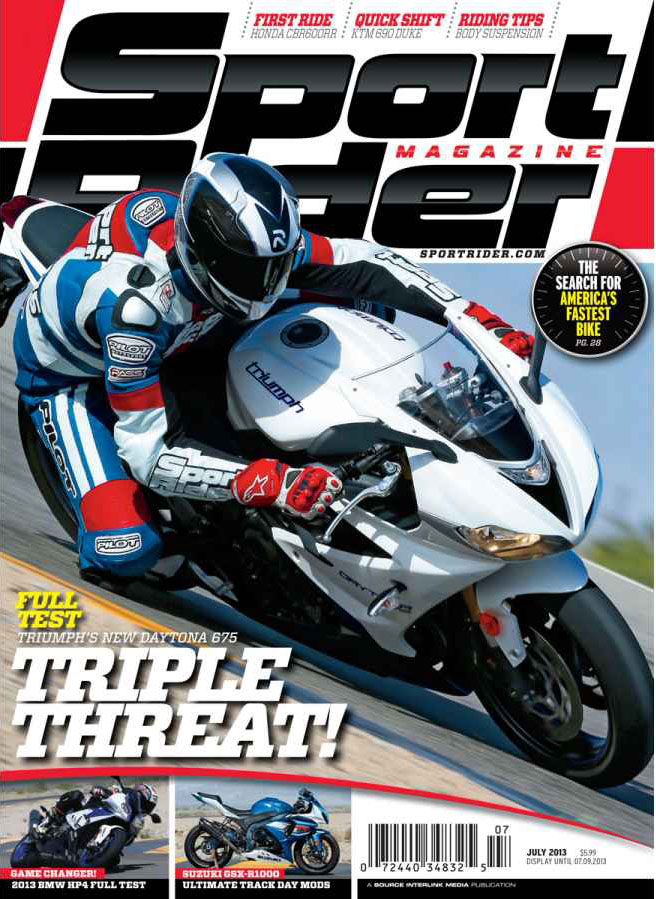
horizontal. Why? For the convenience of a human... Trying to keep your eyes leveled with the horizon while hanging off, puts significant strain on rider's neck and shoulders. Just turn your head all the way to the left, and then try looking up. Pretty uncomfortable, right? It comes as no surprise that it's almost impossible to accomplish this while at the same time hanging off. A rider ends up having his butt partially off the seat, knee sticking out - but rider's upper body goes right back to the bike, with the head right above the tank. Such crooked upper body positions can be observed in most riders, including top racers. Look no further than a rider pictured on the cover of July, 2013 issue of 'Sport Rider' (nothing against Bradley or Kent - their articles are great!)
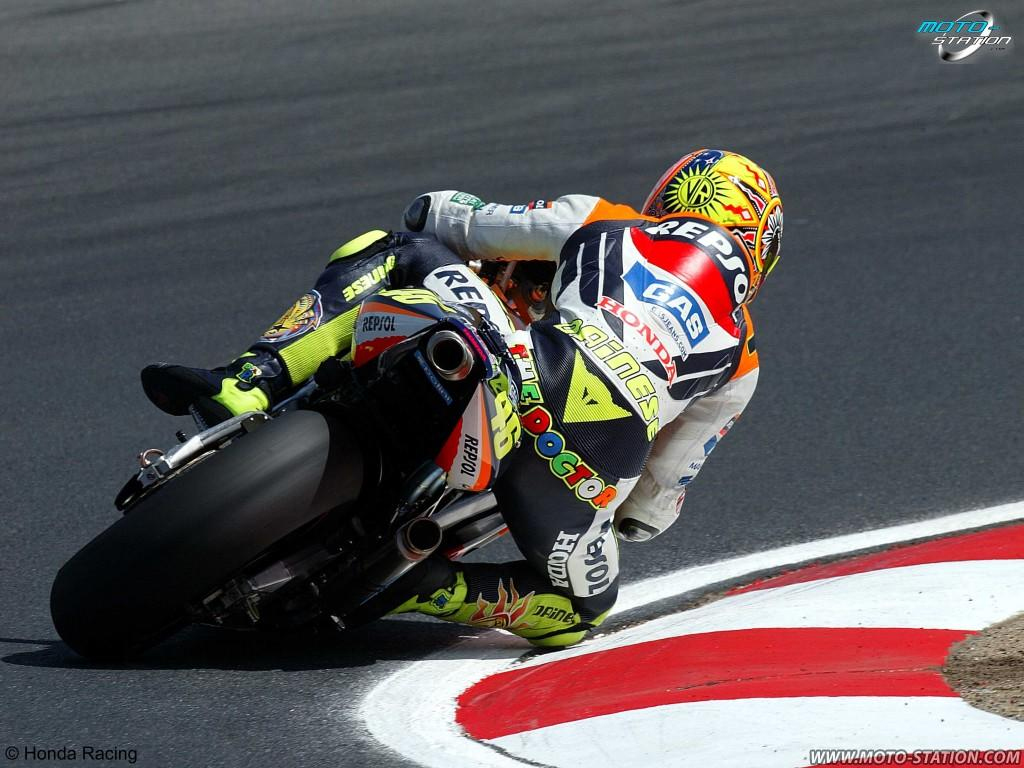
The same could be said about the Doctor himself (see shot below, courtesy of Honda Racing and www.moto-station.com).
It
is simply impossible to have your upper body positioned far away from
the bike while at the same time keeping your eyes in line with the horizon! Not
only rider gets tired from a neck strain occurring in every turn, but what is
even more significant that the effort of moving the rider's body to the
inside of a turn in order to reduce the bike's lean angle gets partially negated
by the fact that the upper body and the rider's head go right back to the
bike, and not away from the bike. As a result, the bike-rider system's center of gravity
(CG) is not shifted to the inside of a turn as far as it could be, which
produces a very incremental reduction of the bike's lean angle or a very incremental
increase in corner speed, which of course
defeats a big part of why a rider hangs off in the first place.
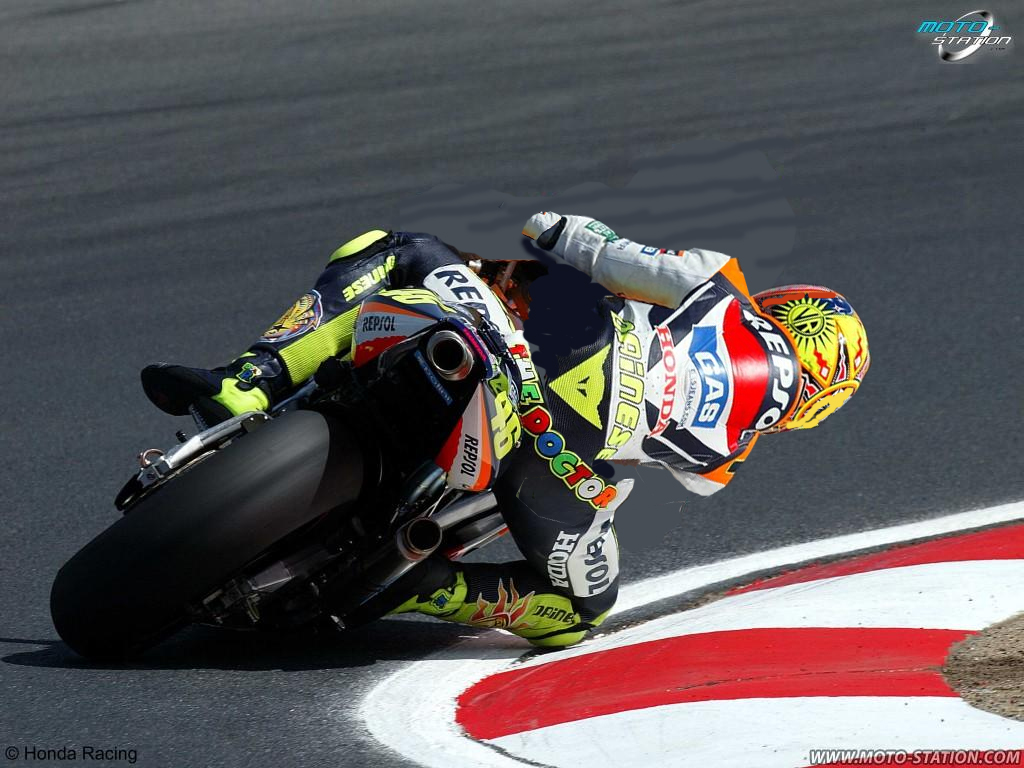
By utilizing Foot Anchors, rider may overcome these challenges. Let's see what happens if rider perceives vertical horizon as a norm. As you lean into a turn, slide to the inside of a turn, and let your upper body naturally rotate around the bike while your outside foot is hooked under the foot anchor. Your torso ends up being parallel to the ground, while one shoulder is facing the ground, another shoulder is facing the sky, and your eyes are up against the inside mirror of the bike (if it has one). Your outside arm is gently resting on the tank. The line of the horizon becomes vertical, or almost vertical. The upcoming turn goes UP in your view of vision. Such new position is depicted using the same image of Valentino Rossi. We took the liberty of performing a slight photo surgery, and rotated Valentino's torso and his head in order to accommodate the new body position. The result is shown below.
As
it is obvious from the photo montage above, all you need to do in order to
look through the turn is to slightly lift your head UP relative to your
torso, which is pretty much what you do on a sportbike anyway. Another way
to look at it, if the bike is leaned at 45 degrees relative to the ground,
and the rider's torso is leaned 45 degrees relative to the bike, the rider's
torso becomes parallel to the ground. The benefits of such approach are plentiful. Of course, the main benefit is the ability to go faster through the same turn while other benefits are secondary. First, your upper body is as relaxed as it was when the bike was going straight. As a result, you are not getting tired as much, less likely to make a mistake, and will enjoy longer rides. Second, seeing the horizon vertical makes it very easy for a human eye to notice the slightest change in lean angle, thus providing an excellent continuous gauging of the lean angle, which also results in greater rider confidence. Third, your torso is going away from the bike and to the inside of a turn, with your head being the farthest part of your body away from the bike – which brings us to the most important benefit: the combined bike-rider CG is significantly shifted to the inside of the turn, allowing to either reduce the bike's lean angle for the same speed, or to go faster through a turn with the same lean angle. Fourth, for high speed turns, the drag caused by your sticking out torso and head helps to slow the bike down in the early part of the turn additionally to trail braking. It also allows to turn-in the bike quicker at the beginning of the turn, while also contributing to a slight turning momentum in the middle of the turn, thus further reducing the lean angle. Fifth, if there is a need to tighten a turn unexpectedly (and we all know that it happens more often than we care to admit), sticking your head and torso just a little bit more out would produce the desired effect almost effortlessly. Sixth, peripheral vision of our eyes in the horizontal plane is pretty wide at about 160 degrees, while peripheral vision in the vertical plane is more narrow at about 120 degrees. When we view a turn in the horizontal plane, the peripheral vision is so wide that it is easy to get lost and start focusing on the wrong part of a turn. When we view a turn in the vertical plane, our vision is not as wide. As a result, we are less likely to get distracted, and stay focused on the important part of a turn. Seventh,
if a motorcycle lowsides in a turn, the rider's torso and head are already
so close to the ground that the impact of the fall is minimal, thus reducing
the chance of an injury. Are there any drawbacks to the proposed body position? There are things to consider... First, like any new riding skill, take your time and adjust your riding gradually. Start with a simple exercise. Walk into any turn (yes, walk in, not ride in) when there is no moving traffic. If it's a right hand turn, stand on your right knee, and support your upper body with your right arm against the ground. Tilt your torso and head to the right as if you are looking under a table, so that the part of the road which turns goes UP in your view of vision. Stay like that for a few moments and observe how the turn looks like from this vantage point. Have a buddy standing guard to make sure you don't get run over. This is how the turn will look like when you ride through it while applying the proposed new body position. If it's a left hand turn, stand on your left knee, and support your upper body with your left arm against the ground. Second, get used to this different view of turns while riding. Increase lean angle gradually and over time. It may feel scary at first, because the perceived lean angle will seem excessive. When this happens, quickly glance at the front wheel in order to confirm that the bike's lean angle is not as extreme. Third, keep in mind that your head sticks out to the inside of a turn farther than before. If you pass someone on their outside, or someone else is passing you on your inside, there is a bigger chance your head may touch the other bike. Leave ample room to avoid this (you do follow a 3 ft rule when riding on the track, don't you?). If a touchdown occurs, don't panic – just ignore it. You are wearing a helmet. Your head, neck, and torso form a flexible structure which will yield a couple of inches automatically if you get a smack on the head (you stay relaxed while riding, right?). Taking a lefthander on the street poses more danger if an oncoming vehicle hugs the centerline – which is true for any riding. The right way to react is to get your head and torso closer to the bike while at the same time adjusting the line to avoid the collision. Resist the temptation to sit up straight as this will either widen your line, or will force you to excessively increase the lean angle. Fourth, you will be questioned by other
riders regarding your “odd” body position. The questions will be
accompanied with rolled eyes and shaking heads. Stay calm, smile a lot, and
take your time to explain the technique. You may doubt whether your eyes and brain can get used to such “extreme” view of the horizon. Think of a jet fighter pilot who is unable to move his body, and as a result has to accept and adapt to any view of the horizon as it comes at him – horizontal, vertical, or upside down. You may be wondering, why really fast riders don't use such a technique? They must be doing all the right things, and don't need any changes. Well, it could be as simple as they haven't thought about it because this approach goes against commonly accepted norm. There are many other factors determining a rider's ability to go fast and safely around a turn, and obviously fast riders understand it and excelled in those respective areas. However, any rider – be it a beginner, an experienced rider, or a champion – would get the benefits explained above if they apply the proposed technique. They will be able to go through the same turns even faster and safer, all other things being equal. Believe it or not, it was the need to accommodate this new body position which lead to the invention of Foot AnchorsTM. |

|
© 2020 Foot Anchors, Patented. |