|
Foot Anchors - there when you need'em TM FootAnchors.com
Home How Foot Anchors Work Home
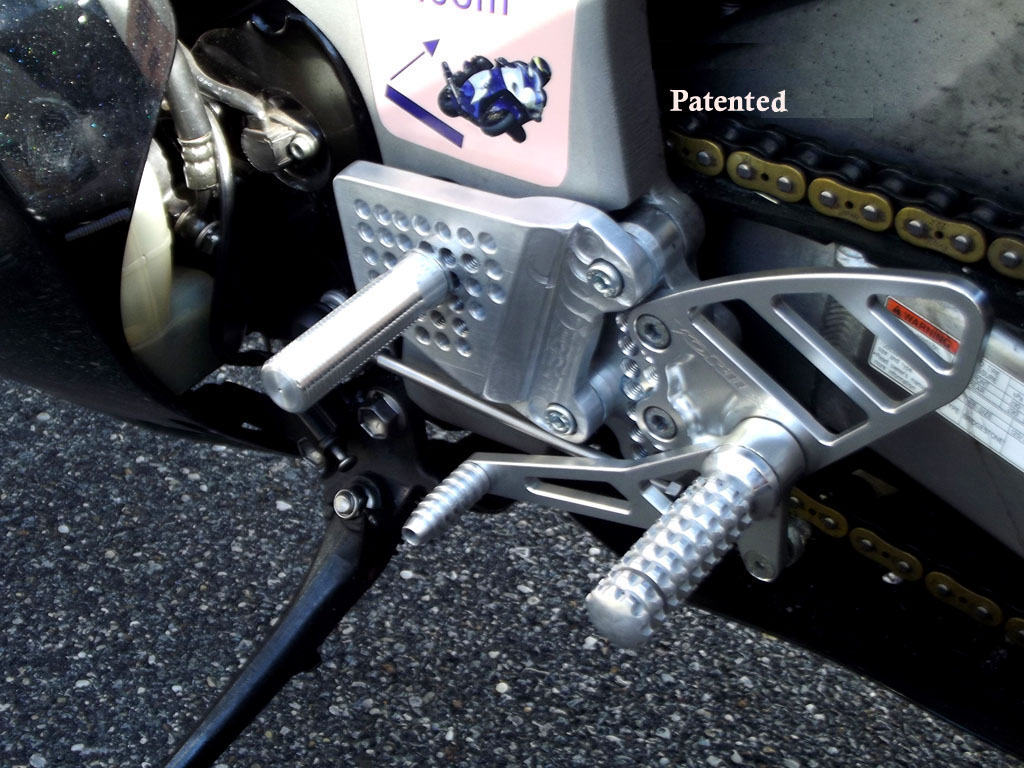
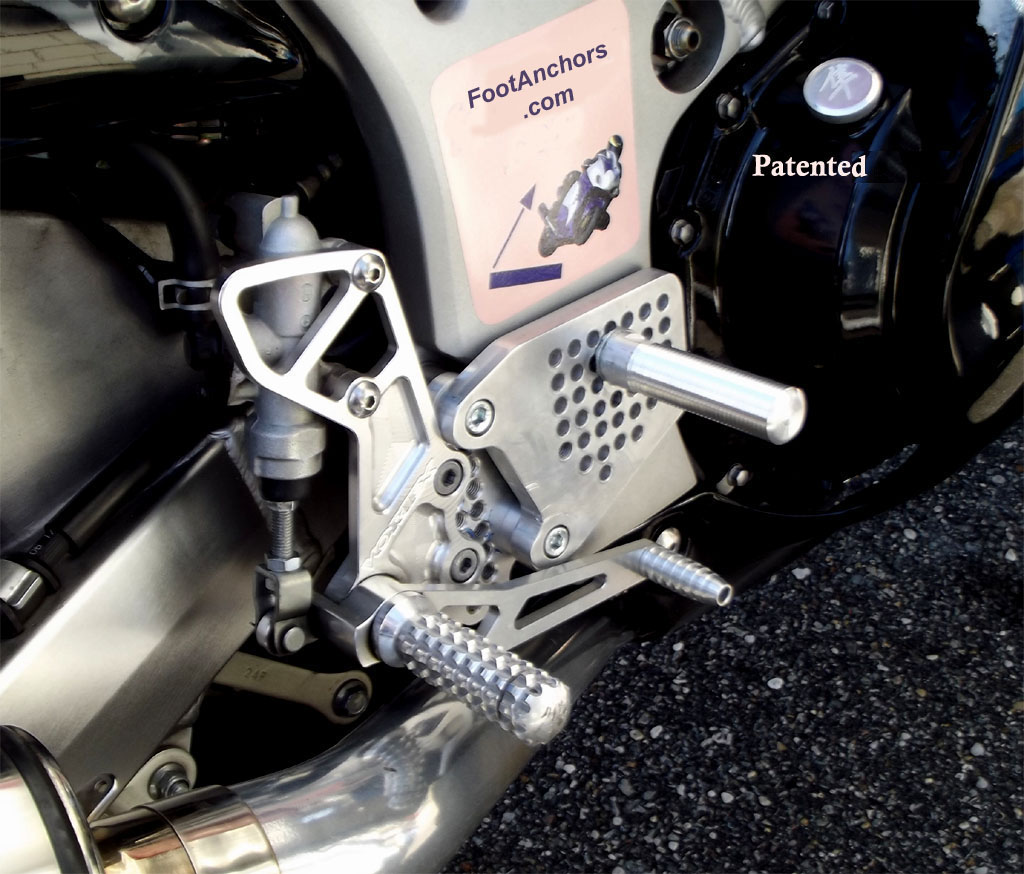
Foot AnchorsTM are installed on a sportbike as follows: one on the left side - about 2-4 inches (5-10 cm) above the shift lever, and one on the right side - similarly, above the rear brake pedal.
Foot anchors look a bit like footpegs, although they are not. Specially designed biased concentric grooves assure that rider's foot reliably stays in place when upward pressure is applied after rider hooks his foot under the foot anchor. Otherwise, rider's foot easily slides out from under foot anchor as if it has smooth and slippery surface.
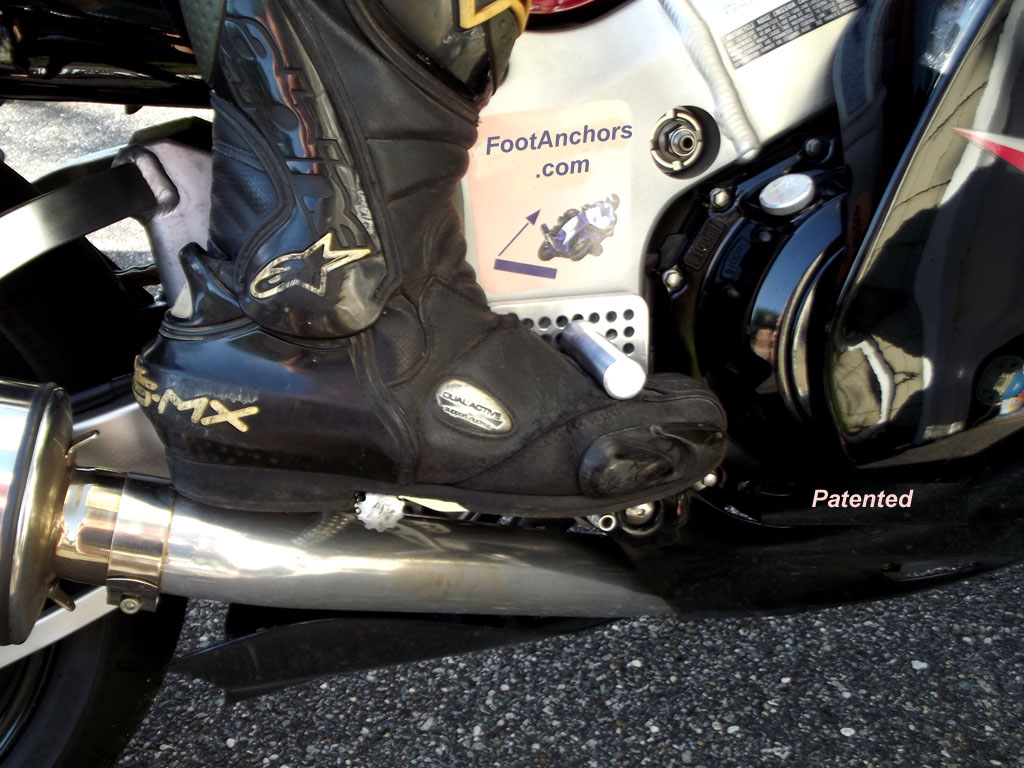
When properly installed, the distance between the left foot anchor and the shift lever is such that there is about 1/4" - 1/2" (0.5-1.5 cm) of free play for your left foot when it is placed under the left foot anchor so it can stay there without exerting any upward pressure on the foot anchor and without any downward pressure on the shift lever. The same applies to the right side of the bike.
Pictures below show our test configuration for the left side of the bike, and for the right side respectfully.
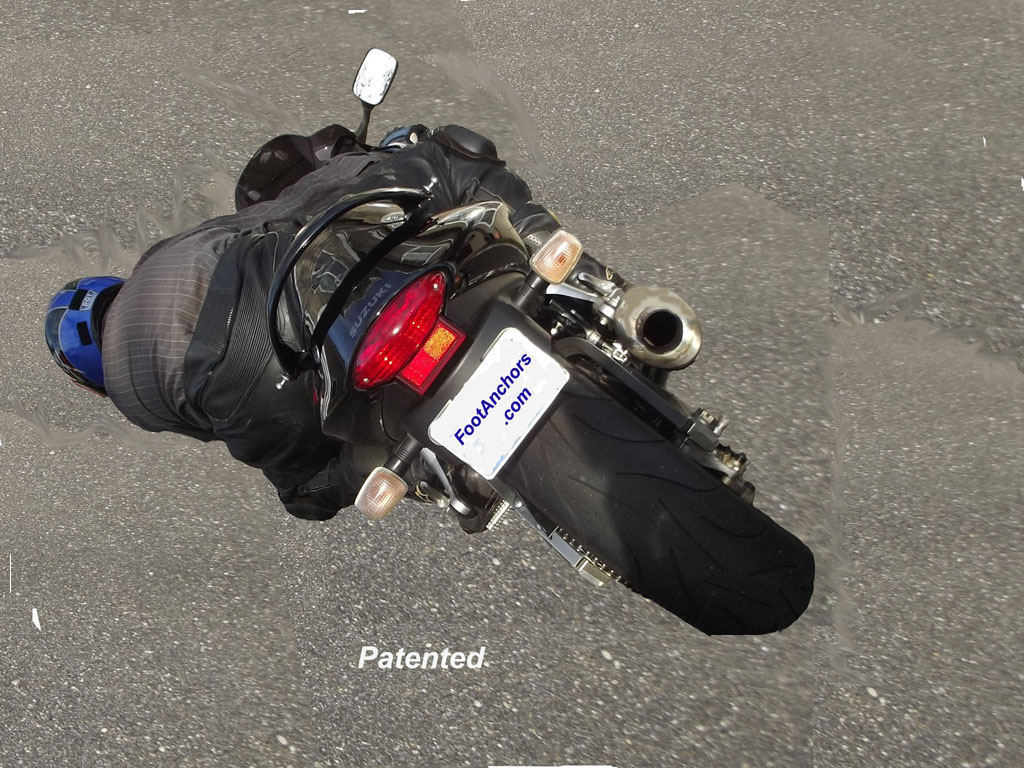
While in turn, rider is able to anchor his/her outside foot under the respective Foot Anchor which effectively holds the outside leg in place. There is no need to press outside knee against the tank.
Simply put, a rider drops his/her body on the inside of a turn. Foot anchor is the only thing that holds the rider in such position. Except for outside foot musle, the entire outside leg is relaxed.
This allows rider to shift the upper body farther to the inside of a turn without the risk of falling off the bike. Ideally, the inside shoulder and hip are very close to the ground. So is the rider's head. The line of horizon in rider's veiw of vision is vertical. This is the most optimal body position from engineering point of view. See more on body position in this article: The New Body Position .
As a result of such body position, the Center of Gravity (CG) of the bike-rider system is shifted farther to the inside of a turn, effectively enabling rider to increase corner speed for the same lean angle of the bike.
Alternatively, this allows to tighten a line through a corner while keeping the bike at the same lean angle.
Additional benefits include quicker turn-in rate, increased stability in turns, improved safety margin, more relaxed body position, and higher rider confidence. All of these factors together greatly contribute to the overall rider improvement, more positive riding experience, and reduced rider fatigue.
Even Valentino Rossi could benefit from the use of Foot Anchors. The following short video illustrates that even Rossi may have trouble anchoring himself to the bike when he tries to move his upper body farther to the inside in order to tighten a line. There are many similar examples of a rider's outside leg going up in the air. In some cases rider actually falls off the bike.
Even Rossi could benefit (video; allow a few seconds to download)
(MotoGP 2014, round 13, Misano circuit in San Marino, qualifying)
The ease of use of Foot Anchors is illustrated in How To Use animation (please disregard old references to 'fasturns' visible in animation) as well as in Riding with Foot Anchors Video.
For more in-depth details, please review Test Rider Impressions.
Many of your questions are answered in FAQ section.
The two front mounting holes for footpeg/rearset mounts should not be obstructed by other elements, otherwise foot anchor Mounting Plate will not fit over. This is usually not a problem for stock footpeg mounts, and for aftermarket rearset mounts. In some rare cases, an aftermarket rearset adjusting plate may partially block the two front mounting holes when a rearset is adjusted too far forward. One way to deal with such situation is to move the rearset backward for a more aggressive riding position, thus providing access to the footpeg/rearset mounting holes.
When taking a left hand turn, a rider places his right foot under the right foot anchor as shown in the picture below.
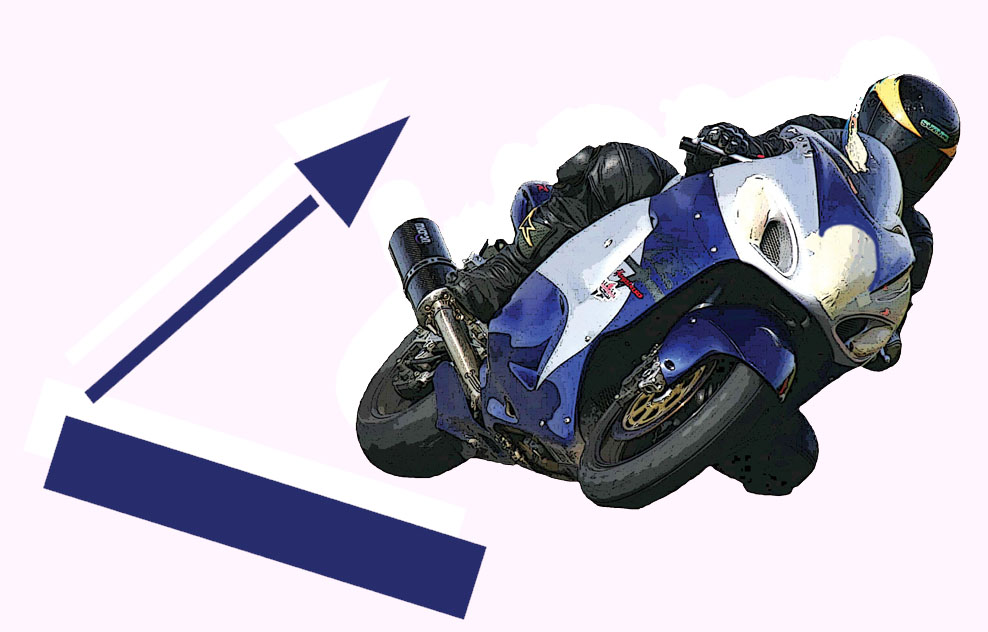
This allows rider to move his upper body farther away from the bike and to the inside of the turn without the risk of falling off the bike as shown in the illustration below.
Because CG of bike-rider system is shifted farther to the inside of the turn, the speed can be increased for the same lean angle. Notice that rider's upper body and his head are far away from the bike.
While in turn, being anchored to the bike prevents the rider from bouncing on the bike going over bumps, or during shakes and slides - thus providing an improved bike's stability. A rider will not fall off the bike due to lost balance because his outside leg is reliably anchored to the bike. This significantly increases rider confidence. Those who have been watching motorcycle racing would be able to easily recall the moments when a top racer fell or almost fell off the bike because of not being able to hold on to the bike with the outside leg.
When entering a turn, a rider is able to move his upper body to the inside of the turn more aggressively and without the risk of falling off the bike - because his outside leg is solidly anchored to the bike - thus, effectively transferring the momentum of the upper body movement into the bike's turning momentum. This significantly quickens the turn-in rate without any additional steering input. In the same way, a rider is able to quicken S-turn transitions.
Being anchored to the bike in turns reduces rider's effort to hold on to the bike. This promotes a more relaxed body position, resulting in reduced rider fatigue, which in turn leads to a more enjoyable riding as well as reduces the possibility of a mistake.
Merits of this invention have been privately recognized by others in motorcycling community, including aftermarket manufacturers, tuners, other test riders, track coaches, and racers.
Many of your questions are answered on FAQ page. The simplicity of Foot Anchors and their ease of use is illustrated in How To Use animation.
When utilizing Foot Anchors, rider's body position becomes more comfortable and relaxed. A rider may notice that his/her body position starts evolving. Such evolution leads to the most efficient body position described in The New Body Position article.
|

|
© 2020 Foot Anchors, Patented. |